Vitalik Buterin is a Canadian-Russian programmer, co-founder and former editor of the print magazine Bitcoin Magazine, billionaire, and co-founder of the Ethereum project (Ethereum cryptocurrency), for the concept of which in 2014 he won the World Technology Award, surpassing Facebook founder Mark Zuckerberg and other contenders. He was born on January 31, 1994, in Kolomna, Russia.
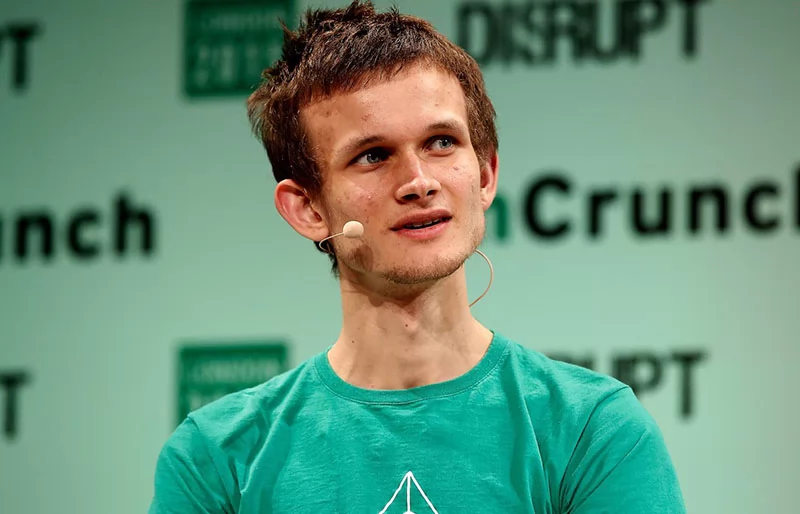
Buterin's Stance on the War in Ukraine
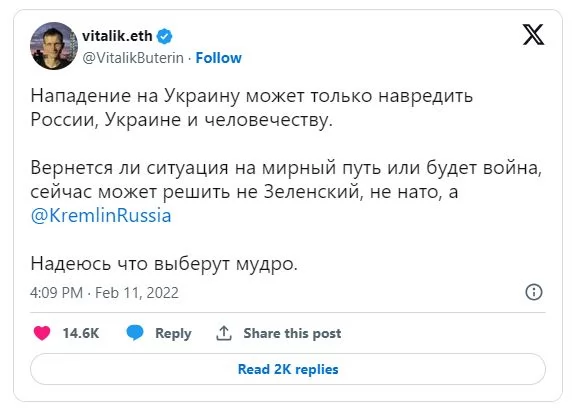
Back on February 11, 2022, Vitalik Buterin spoke out on his Twitter account regarding a potential war between Russia and Ukraine, expressing hope for a "wise" decision by the Kremlin:
An attack on Ukraine can only harm Russia, Ukraine, and humanity. Whether the situation returns to a peaceful path or there will be war cannot be decided right now by Zelenskyy, nor by NATO, but by the Kremlin. I hope they choose wisely.
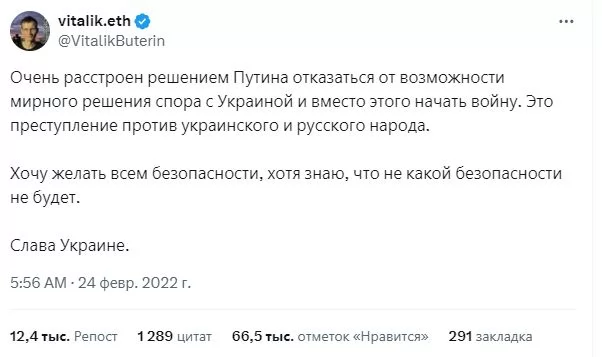
On the day Russia launched its full-scale invasion of Ukraine, Vitalik unequivocally spoke out against the war:
Very upset by Putin's decision to abandon the possibility of a peaceful resolution of the dispute with Ukraine and start a war instead. This is a crime against the Ukrainian and Russian people. I want to wish safety to everyone, although I know there will be no safety. Glory to Ukraine.
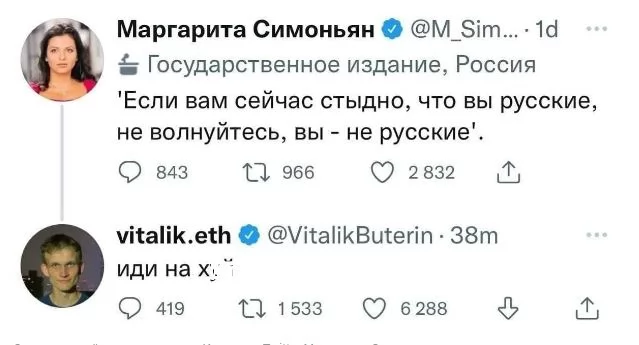
Vitalik has made numerous statements both in support of Ukraine and against the Russian regime. For instance, beneath a post by Margarita Simonyan about "who is ashamed to be Russian", Vitalik bluntly told Russia's chief propagandist to f*** off:
Financial Support for Ukraine
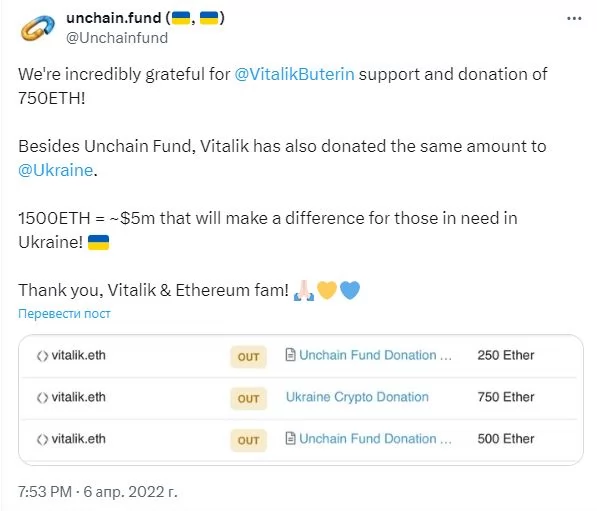
In April 2022, the billionaire donated 1,500 coins of his own cryptocurrency ($5 million) to the Unchain Ukraine fund, which provides humanitarian aid to Ukrainians. Buterin sent two additional donations of the same amount to the crypto fund of Ukraine wallets.
Buterin's Statement in 2026
In February 2026, Vitalik Buterin published a series of statements on the social network X. In them, he explained his stance on the war, criticized the Kremlin, and discussed the future of Russia after Putin:
I support Ukraine and state that this war is criminal aggression, not 'a complicated situation where both sides behaved dirtily.' Putin claimed he wanted to protect Donbas, but attacked the entire country — from Kherson to Kyiv.
He emphasized that Vladimir Putin's refusal to seize a chance for peace merely confirmed his responsibility for continuing the war:
Trump and Vance, from their meeting with Zelenskyy in February 2025 to this day, have acted like complete pigs, but they did us a very important service — they gave Putin such a good opportunity to agree to peace and look like a hero in front of the world, that when Putin did not take this chance, it became obvious to everyone because of whom this criminal war continues.
Buterin distinguishes between the responsibility of the regime and that of society:
Putin is the devil, while the people of Russia are neither angels nor devils. You can only help Putin jump from a high balcony or drink tasty KGB-style «tea.» But after Putin, we must help the most «non-cannibalistic» faction in the Russian Federation (...) win in the internal «game of thrones.
In his view, long-term security for Ukraine and Europe is only possible through the transformation of Russia itself:
What will the 'beautiful Russia of the future' look like? The most stable security guarantee for Ukraine and Europe is for the Russian Federation itself to transform into a structure that poses no threat to them.
Right now, the opposition desperately needs new heroes and new ideas.
A positive future for Russia can be built on the ideas of decentralization and digital democracy.
Thus, Buterin not only offers a stringent evaluation of the war as criminal aggression, but also proposes a strategic vision of the future — where Russia ceases to be a source of threat, and domestic political processes are founded on newer, more open, and distributed governance principles.



Comments section (2)