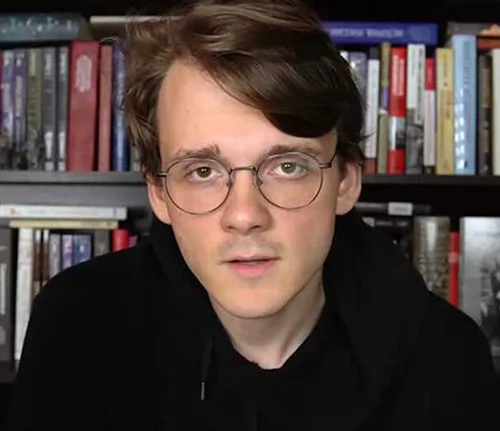
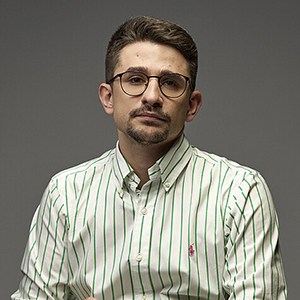
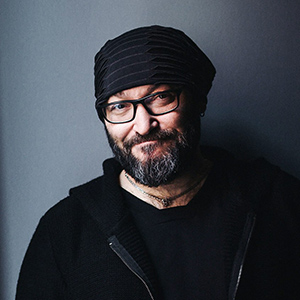
Aleksandr Shtefanov is a Russian blogger and YouTuber. He gained widespread popularity thanks to historical and political analysis videos on YouTube and TikTok. He was born on May 21, 1999, in Moscow.
Warning. Despite anti-war statements, this person remains part of the Russian information space. If you choose to consume their content, please evaluate the expressed opinions critically and verify information through independent sources.
Stance on the war in Ukraine
Following Russia's full-scale invasion of Ukraine, Aleksandr Shtefanov attempted to strike a balance between both camps, debunking both Russian and Ukrainian war fakes. Formally, Shtefanov opposed the war, but proposed a way to end it that involved Ukraine abandoning attempts to reclaim occupied territories and agreeing to terms favorable to Russia.
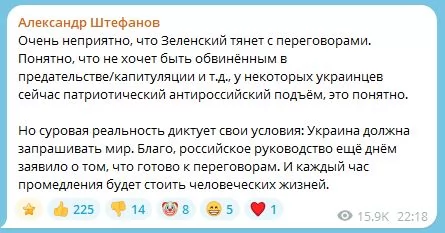
He broadcast arguments that Ukraine is weaker, incapable of fighting without partners' aid, and therefore must accept the Kremlin's terms to prevent bloodshed. Later, however, he himself "capitulated before Russia":
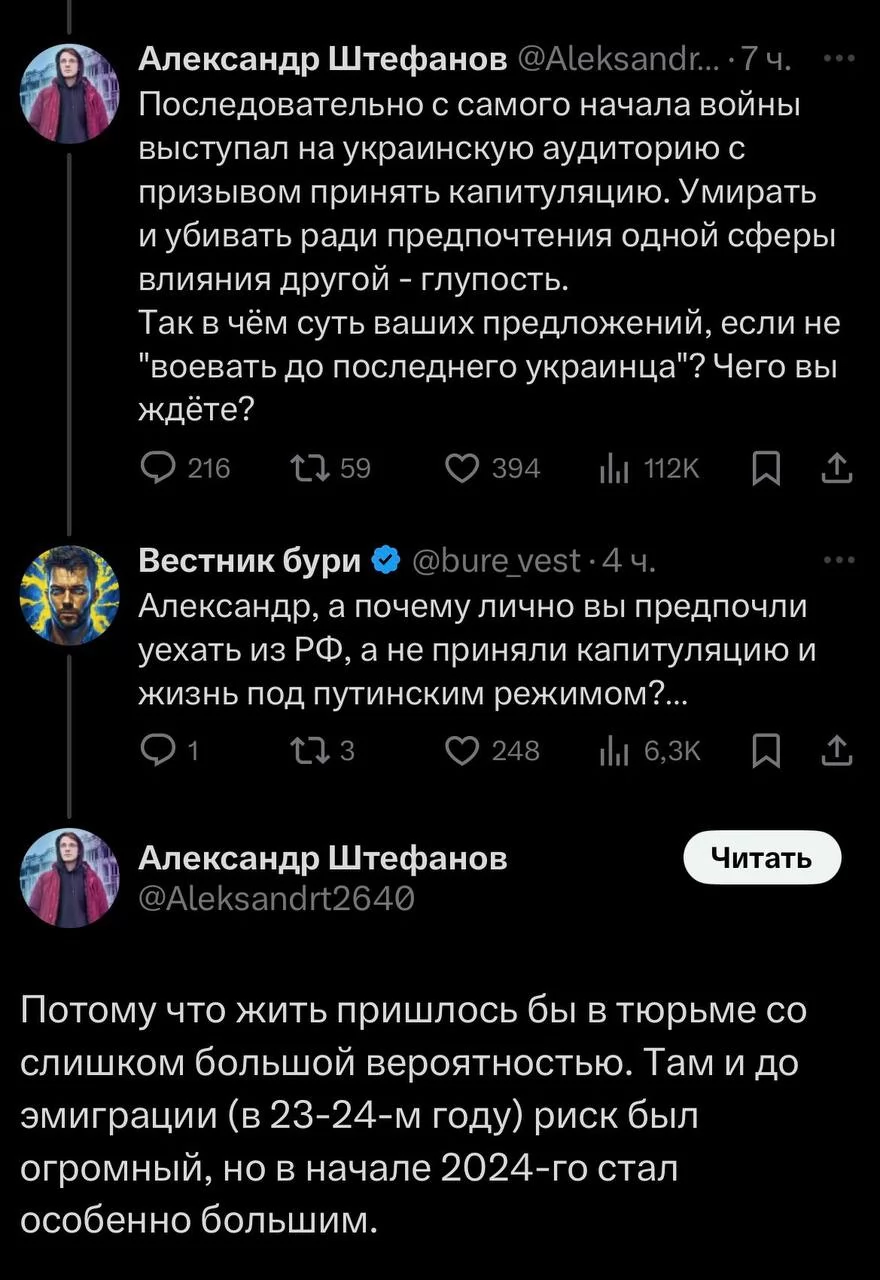
What Shtefanov proposes to end the war
- War is a senseless slaughter: Hostilities bring unimaginable suffering and tens of thousands of deaths. Continuing the war makes no sense, as it merely leads to "marking time" and immense new casualties without significant shifts in the frontline.
- Ukrainian society is critically exhausted: People are tired of the conflict, as evidenced by harsh forced mobilization and men drowning in the Tysa River while attempting to avoid the draft. He references polls indicating a steady rise in the number of Ukrainians who favor an immediate ceasefire.
- Danger of nuclear catastrophe: Striving for the "complete defeat" of Russia is reckless. Cornered leadership of a nuclear power could use nuclear weapons, turning territories into a "radioactive wasteland".
- Freezing the conflict as salvation: Historical precedents (e.g., Korea and Transnistria) prove that a "frozen" conflict is a viable solution. Even a few years or decades of peace hold immense independent value, allowing new generations to live without warfare.
- Rejection of reparations: He opposes classic state reparations to Ukraine. Drawing on the historical experience of Germany, he argues that such payments would become a national humiliation for Russians and provoke renewed revanchism.
Documentary «Ordinary Denazification»
In February 2023, Shtefanov released the documentary film «Ordinary Denazification» about life in the occupied areas of Donetsk Oblast in Ukraine. To shoot the film, Shtefanov traveled to Donetsk and Mariupol (illegally crossing the border) as a volunteer in a humanitarian mission organized by the Russian center "Society.Future".
Main conclusions of the film:
- Large-scale catastrophe: Mariupol was almost entirely destroyed in just a month and a half. Concurrently, brutal mobilization was taking place in the "DPR": the male population, including students, elderly men, and individuals with disabilities, was sent en masse "to the slaughter" without proper training or equipment.
- Antagonism between Donetsk and Mariupol: Mariupol residents do not relate to the propaganda narrative of "bombing Donbas for 8 years", since their city lived peacefully and developed dynamically until 2022. Against this backdrop, some mobilized men from Donetsk justified their looting in Mariupol by arguing that Mariupol residents "lived well" while Donetsk suffered.
- Pointlessness of the war's pretexts: Only around 20% of the population remained in Mariupol, and even those loyal to Russia did not understand why Russia launched the full-scale invasion. The status of the Russian language before 2022 was not a critical issue — minor restrictions were seen by locals merely as a slight inconvenience that certainly did not warrant war.
- Repressions and fear: Many pro-Ukrainian citizens remain in the occupied territories, but they are forced into hiding. People can be detained, subjected to torture in detention "basements", or face criminal prosecution over a simple denunciation or a TikTok video.
Following the film's release, the blogger received threats from Russian-installed "authorities" in the so-called "DPR" and from Aleksandr Ionov, author of numerous denunciations against independent Russian media.
What Shtefanov says about Crimea
Shtefanov asserts that the vast majority of Crimeans want to live as part of Russia and opposes returning Crimea to Ukraine:
The reconquest of Crimea by the Armed Forces of Ukraine would turn the beautiful city of Sevastopol into Stepanakert... But, at the same time, is it fair that all residents of that territory should have to leave it in order for international law to prevail? In my view: no... There are various political formulas. There is dual jurisdiction. The issue of Gibraltar was discussed. Independent state status, to draw a direct analogy with Kosovo. There are different options. But, one way or another, one cannot simply take and hand Crimea over to Ukraine.
In September 2024, Shtefanov was added to the database of the Myrotvorets website for participating in attempts to legitimize the annexation of the Autonomous Republic of Crimea and manipulating public consciousness.
In an interview with Yury Dud on the Crimean issue, Aleksandr stated that he does not consider internationally recognized borders an indisputable authority and is unsure that international law alone defines the legitimacy of territories. For him, a state is primarily about people, rather than "a piece of land drawn with a ruler on a map".
He emphasizes that Crimea was the only entity in Ukraine where the majority was a Russian population that sincerely identified with Russia. He also added that the annexation of Crimea was a terrible mistake due to the risks it posed for Russia. Despite local support, Shtefanov states that had he been asked in 2013 whether Crimea should be taken, he would have answered "unquestionably no".
Statements about the Russian language in Ukraine
During a debate with Maxim Katz regarding the language issue in Ukraine, Shtefanov claimed that «the Ukrainian national idea is largely anti-Russian» and asserted that systemic discrimination against Russian speakers exists in Ukraine. In doing so, he effectively shifted part of the blame for the war onto the victim: the blogger directly labeled the shutdown of pro-Russian TV channels and restrictions on the Russian language in schools prior to 2022 as «one of the invasion's triggers». Thus, Shtefanov shifts focus away from Putin's imperial ambitions toward Ukraine's internal policies, concluding that Ukrainians' defense of their own cultural and informational space provoked the aggressor.
Notably, this rhetoric directly contradicts his own conclusions from Mariupol, where he acknowledged that the language issue had never been a genuine pretext for launching hostilities.
On the YouTube channel "Kharoshi Raguli", one can find a detailed breakdown of Shtefanov's statements on language policy along with an analysis of his quotes, such as:
Discrimination on ethnic and linguistic grounds in the 21st century is barbarism, and Ukraine is showcasing this barbarism in all its glory.
The Russian language was always banned in Ukraine, and I have plenty of evidence... We see examples of militant discrimination.
Controversial statements about the history of Ukraine
In December 2025, during a lecture in Warsaw, Aleksandr Shtefanov focused on harsh criticism of Ukrainian national memory. In brief, his key points were:
-
The Holodomor was not an intentional genocide of Ukrainians, but a «shared tragedy» of the USSR, from which Ukraine made a «carbon copy of the Holocaust».
-
Ivan Mazepa was an unequivocal traitor who simply broke his oath to Peter I, rather than a national hero.
-
Stepan Bandera was a terrorist and xenophobe, and responsibility for the 1941 Jewish pogrom in Lviv (prior to the arrival of the Germans) rests with the Ukrainian militia. According to Shtefanov, Stepan Bandera and his followers played a major role in stoking antisemitic sentiments by calling to «bring liberation to Ukrainian soil so that not a katsap, nor a yid, nor a lyakh remains on it». In Shtefanov's view, this later also led to the Volhynia massacre.
-
Rebuttal of the «slave mentality» of Russians: In the late 1980s and early 1990s, democratic protests were boiling in the RSFSR, whereas Ukraine at the time remained a passive «sanctuary of stagnation».
-
Defense of Russian interests in Crimea: Ukraine's attempts to criminally prosecute individuals for collaborating with Russian authorities on the peninsula (citing Russian archaeologist Butyagin detained in Poland) will result in Ukraine «never returning there in any shape or form».
By voicing these points in Poland — amid the Polish-Ukrainian historical controversy actively stoked by Russian propaganda — Shtefanov effectively operates within its logic, bringing sensitive topics to an international audience, undermining the reputation of Ukrainians among allies, and inciting mutual distrust.
Pressure from Russian authorities and subsequent activities
In August 2023, he was designated a «foreign agent» by the Ministry of Justice of the Russian Federation for his anti-war stance and criticism of the government.
In February 2024, he left Russia.
In December 2024, Aleksandr Shtefanov registered in the bloggers registry, supporting Roskomnadzor. Later, records of his registration in the registry were removed.




Но давай даже на это закроем глаза. Есть ещё более принципиальный момент: Штефанов утверждает, что Крым российский. Вторить кремлевским тейкам - помогать кремлю в пропаганде. А это вообще не клеится с последовательной антивоенной позицией.
Да вроде вполне здравые взвешенные позиции по всем вопросам. Да, их можно обсуждать, спорить, но ничем *етным тут и не пахнет. Штефанов всегда был против войны, причем любой войны. Он подтверждал на стриме, что выступил бы и за "капитуляцию" России в случае нападения на нее более сильного противника - это прямо следует из его пацифситко-толстовско-христианских взглядов.Ну и не поддержка и осуждение украинской власти не ставит тебя на сторону апологетов войны (см. того же Елисевича)
В лучшем случае - агент влияния кремля по причине дурак/хайпожор, в худшем - сознательный. Но сути его деятельности это не меняет.
Поэтму как у россиянина у меня к нему много претензий.
На счет репараций: там нюанс. Он считает, нужно платить компенсации, а не репарации или чтобы россия не деньги на востановление украине платили, а сама ее восстанавливала. Мол, чтобы россияне не чувствовали себя униженными и не росли реваншистские настроения
На счет крыма: крым впервую очередь пренадлежит крымчанам, когда какие-то страны кричат "крым наш" - это имперство. Так что у крымчан должен быть выбор
Дивлячись на опис, складає враження, що він всеодно повинен бути у вкладці "За війну" за фактами його висловлювань. Недивлячись на антивоєнну позицію, його риторика всеодно кремлівська й полягатиме на війну на вже підконтрольні під РФ території.
Личинка *атного жука - это если коротко. Как можно вообще серьезно воспринимать всех этих штефановых, кацев, панасенковых, дудей
Людей наверное задалбывает уже, что русские могут спокойно шутить с Бучи, и их никто не осудит с их же народа (как минимум я не видел такого), но вот если кто то с наших про Крокус или Суджу пошутит, то мы сразу ужасные, такие же как *етники и вообще без человечные. Естественно, те**акты/ре*ня это ужасно, но имеем что имеем, войны убивают все границы морали у большинства людей, особенно тех, кого затронула война лично.
Чзх, российского блогера больше заботит судьба России и русских, чем судьба украинцев? Ну реально ***етник, как так можно
Наверное, администраторы сайта Вас услышали